




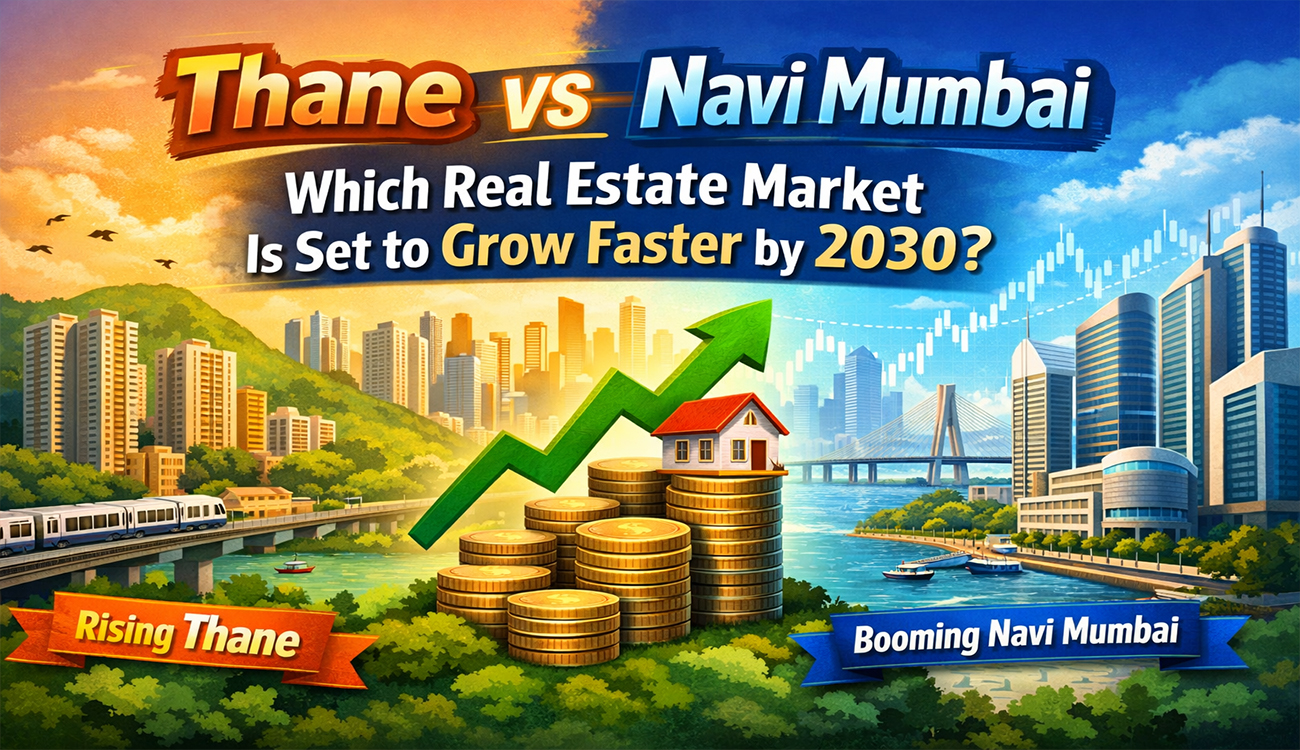
The Mumbai Metropolitan Region (MMR) is entering a decisive phase of real estate transformation. As Mumbai’s core areas become saturated and unaffordable, growth has decisively shifted toward well-planned peripheral markets. Among them, Thane and Navi Mumbai stand out as the two strongest contenders for long-term real estate appreciation.
Both markets have evolved far beyond being “extended suburbs.” Today, they are self-sustaining urban ecosystems with employment hubs, social infrastructure, connectivity upgrades, and massive government-led projects. The critical question for homebuyers and investors is: between Thane and Navi Mumbai, which market will grow faster over the next five years?
This detailed comparison analyses infrastructure, pricing, demand drivers, supply pipeline, rental potential, and future catalysts to help you make an informed decision.
Understanding the Growth Context of MMR
MMR’s expansion is no longer horizontal—it is strategic and infrastructure-led. Large-scale projects like metro corridors, coastal connectivity, new airports, trans-harbour links, and business districts are reshaping buyer preferences.
Thane and Navi Mumbai benefit differently from this growth:
- Thane thrives as a central connector between Mumbai, Western Suburbs, and Central India
- Navi Mumbai is emerging as a globally connected, planned city with aviation and logistics dominance
Their growth trajectories are strong—but distinct.
Thane Real Estate Market: Growth Drivers and Outlook
Strategic Location Advantage
Thane’s biggest strength is its geographical centrality. It connects Mumbai, Navi Mumbai, and extended regions like Kalyan-Dombivli, Bhiwandi, and even Nashik via highways and rail.
Key connectivity advantages include:
- Eastern Express Highway
- Ghodbunder Road (linking Eastern and Western suburbs)
- Central Railway suburban line
- Upcoming Metro Lines 4, 5, and 10
This makes Thane a preferred location for professionals working across MMR.
Infrastructure Boom Fueling Thane’s Growth
Thane is witnessing one of the most aggressive infrastructure upgrades in Maharashtra.
Major projects shaping the next five years:
- Metro Line 4 (Wadala–Kasarvadavali) improving Mumbai–Thane commute
- Metro Line 5 (Thane–Kalyan) unlocking extended suburbs
- Metro Line 10 (Gaimukh–Shivaji Chowk) boosting Ghodbunder belt
- Thane–Borivali Twin Tunnel reducing travel time drastically
- Coastal Road extension connectivity
These projects directly translate into higher real estate demand and price appreciation.
Residential Demand and Buyer Profile in Thane
Thane attracts a wide buyer spectrum:
- End-users upgrading from Mumbai suburbs
- First-time buyers from extended suburbs
- Investors seeking stable rentals
Its appeal lies in:
- Large integrated townships
- Green cover and lakes
- Competitive pricing compared to Mumbai
- Strong social infrastructure
Areas like Majiwada, Pokhran Road, Ghodbunder Road, Balkum, and Manpada are becoming premium residential zones.
Pricing and Appreciation Trends in Thane
Current average prices (approximate):
- Mid-segment: ₹10,000–14,000 per sq ft
- Premium micro-markets: ₹18,000–22,000 per sq ft
Over the next five years, Thane is expected to see:
- Steady appreciation of 6–8% annually
- Strong absorption due to end-user dominance
- Lower volatility compared to speculative markets
This makes Thane a low-risk, consistent growth market.
Rental Market Strength in Thane
Thane’s rental demand is driven by:
- Corporate employees
- IT professionals
- Families relocating from Mumbai
Rental yields range between 2.8%–3.5%, supported by:
- New inventory
- Large societies with amenities
- Excellent connectivity
This stability makes Thane attractive for long-term income-focused investors.
Navi Mumbai Real Estate Market: Growth Drivers and Outlook
Planned City Advantage
Navi Mumbai’s biggest strength is its planned urban design. Wide roads, organized sectors, dedicated commercial zones, and green spaces make it fundamentally different from organic city growth.
Nodes like Vashi, Nerul, Belapur, Kharghar, Panvel, Ulwe, and Dronagiri each serve distinct residential and commercial purposes.
Navi Mumbai International Airport: The Game Changer
The single biggest catalyst for Navi Mumbai is the Navi Mumbai International Airport (NMIA).
Its impact includes:
- Global connectivity
- Corporate and logistics influx
- Hospitality and commercial growth
- Massive residential demand
Locations such as Ulwe, Panvel, and Dronagiri are already witnessing accelerated price movement due to airport-led development.
Connectivity Projects Powering Navi Mumbai
Navi Mumbai is emerging as a multi-modal connectivity hub.
Key infrastructure projects include:
- Mumbai Trans Harbour Link (Atal Setu) connecting Sewri to Nhava Sheva
- Coastal Road connectivity extensions
- Metro Line 1 (Belapur–Pendhar) and upcoming extensions
- Dedicated Freight Corridor
- Rail and port connectivity
These projects position Navi Mumbai as a business and logistics powerhouse.
Employment and Commercial Growth
Unlike Thane, which depends heavily on Mumbai employment, Navi Mumbai is becoming self-reliant.
Major employment drivers:
- MIDC industrial zones
- Corporate offices in Belapur and Vashi
- IT parks in Ghansoli
- Logistics and warehousing near JNPT
- Airport-driven commercial hubs
This creates organic housing demand and higher future rental yields.
Pricing and Appreciation Trends in Navi Mumbai
Current average prices:
- Established nodes: ₹15,000–22,000 per sq ft
- Emerging nodes: ₹9,000–13,000 per sq ft
Over the next five years, Navi Mumbai is expected to witness:
- Higher appreciation of 8–12% annually in airport-influenced zones
- Faster capital growth in emerging micro-markets
- Short-term volatility but strong long-term upside
This makes Navi Mumbai a high-growth, opportunity-driven market.
Rental Market Potential in Navi Mumbai
Rental demand is rising due to:
- Corporate offices
- Port-related industries
- Airport-linked employment
While current yields average 2.5%–3%, they are expected to improve post-airport operations.
Thane vs Navi Mumbai: Key Comparison
Infrastructure Impact
- Thane: Metro-led urban mobility improvement
- Navi Mumbai: Airport-led global connectivity
Growth Nature
- Thane: Stable, end-user driven
- Navi Mumbai: Aggressive, infrastructure-triggered
Risk Profile
- Thane: Lower risk, predictable growth
- Navi Mumbai: Higher upside with moderate execution risk
Investor Suitability
- Thane: Families, salaried professionals, conservative investors
- Navi Mumbai: Long-term investors, NRIs, capital appreciation seekers
Which Market Will Grow Faster in the Next 5 Years?
From a pure growth acceleration perspective, Navi Mumbai is likely to grow faster due to:
- International airport impact
- Commercial and logistics expansion
- Lower base prices in emerging nodes
- Government-backed mega infrastructure
However, Thane will remain more stable and consistent, delivering reliable appreciation with lower downside risk.
Strategic Investment Insight
The smarter approach is not choosing one over the other blindly—but aligning with your goals:
- If you want predictable growth, steady rentals, and lifestyle living, Thane is ideal
- If you want higher appreciation, future-ready infrastructure, and long-term upside, Navi Mumbai offers stronger growth potential
Many seasoned investors are diversifying across both markets to balance stability and growth.
Conclusion
Thane and Navi Mumbai are not competitors—they are complementary growth engines of MMR. Over the next five years:
- Navi Mumbai may outpace Thane in percentage appreciation
- Thane will continue to outperform in absorption, rentals, and end-user demand
Your ideal choice depends on time horizon, risk appetite, and investment objective.
If you are planning to invest or buy a home in either Thane or Navi Mumbai, Horizon helps you evaluate verified projects, compare micro-markets, and choose the right opportunity based on data—not hype.
Growth is coming. Choose the market that grows with your goals—choose Horizon.


