






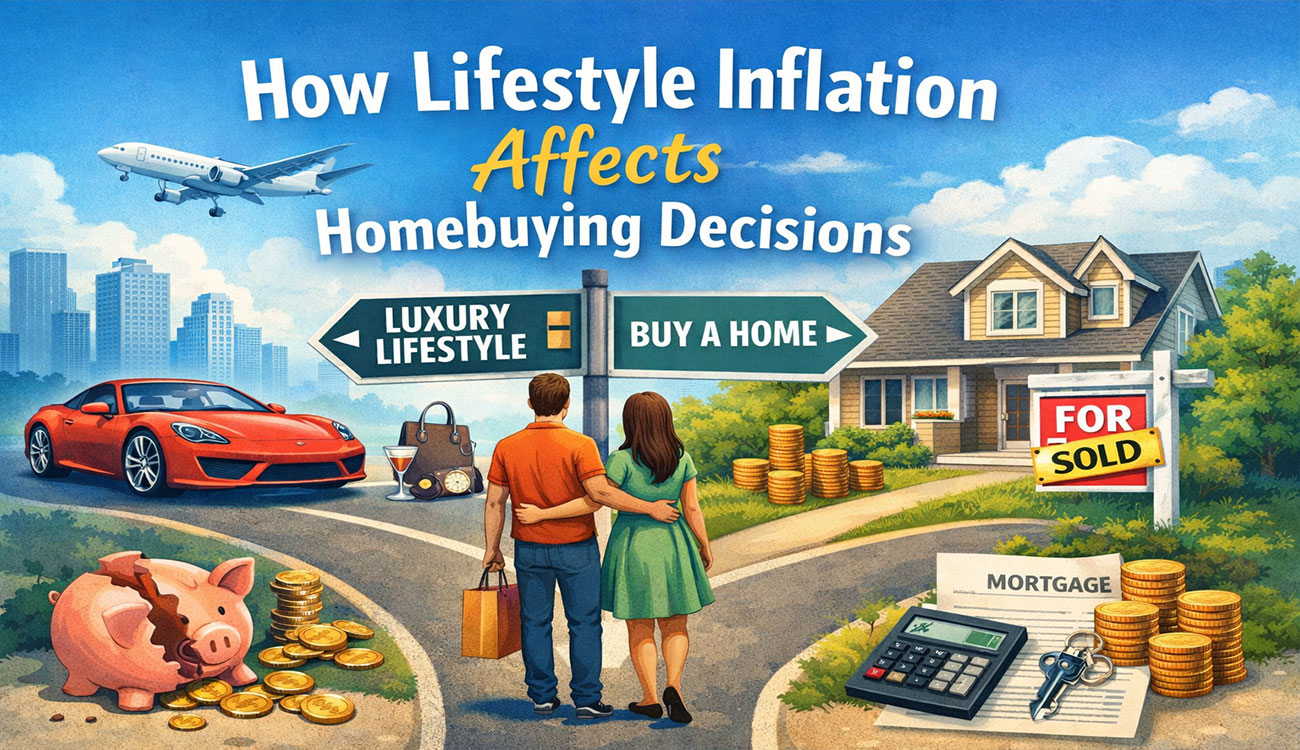
Lifestyle inflation is a subtle but powerful force shaping modern homebuying behavior. As incomes rise, so do expectations—larger homes, better locations, premium amenities, upgraded interiors, and aspirational lifestyles. While this progression is natural, it often blurs the line between financial capability and financial comfort. In real estate, lifestyle inflation can significantly influence not just what people buy, but how they buy, when they buy, and the long-term financial consequences of those decisions.
In today’s urban markets, especially in metro and Tier-1 cities, homebuying is no longer driven purely by necessity. It is deeply intertwined with social status, peer comparison, lifestyle branding, and future aspirations. Understanding how lifestyle inflation impacts homebuying decisions is essential for buyers who want to build wealth responsibly, not just own impressive assets.
What Is Lifestyle Inflation?
Lifestyle inflation refers to the tendency of individuals to increase their spending as their income rises. Promotions, business growth, bonuses, or career stability often trigger higher discretionary spending—better cars, premium gadgets, international travel, fine dining, and eventually, more expensive homes.
In real estate, lifestyle inflation manifests through:
- Choosing larger homes than necessary
- Upgrading locations beyond functional needs
- Opting for premium amenities with recurring costs
- Stretching budgets assuming future income growth
While each of these choices may seem justified individually, together they can place long-term stress on household finances.
The Psychological Drivers Behind Lifestyle-Driven Homebuying
Homebuying decisions are rarely purely rational. Psychological factors play a significant role in how lifestyle inflation influences choices.
Social comparison is one of the strongest drivers. Buyers often benchmark themselves against peers—colleagues buying luxury apartments, friends upgrading to gated communities, or social media showcasing aspirational living. This creates a perceived need to “level up,” even if the financial readiness is marginal.
Another factor is identity reinforcement. Homes are seen as extensions of personal success. A bigger or more premium home becomes symbolic proof of professional and financial achievement, making it emotionally difficult to choose modest or conservative options.
There is also optimism bias—the belief that future income will comfortably cover current financial stretch. This assumption often underestimates uncertainties such as job changes, business cycles, health issues, or economic downturns.
How Lifestyle Inflation Changes Budget Calculations
Traditionally, home affordability was assessed using conservative ratios—EMIs capped at 30–35% of monthly income, reasonable down payments, and sufficient emergency buffers. Lifestyle inflation quietly alters these benchmarks.
Buyers influenced by lifestyle upgrades often:
- Accept EMIs of 45–55% of income
- Reduce down payment to preserve lifestyle liquidity
- Rely heavily on dual-income assumptions
- Underestimate future expenses like schooling, healthcare, and lifestyle maintenance
This recalibration increases vulnerability. A home that is technically affordable on paper may not be comfortably sustainable in real life.
Location Upgrades and the Lifestyle Premium
One of the most visible impacts of lifestyle inflation is location selection. Buyers increasingly prioritize neighborhoods with social prestige, premium retail access, cafés, international schools, and lifestyle hubs.
While such locations offer superior living experiences, they also carry a significant price premium. Buyers may end up paying 25–40% more for lifestyle-driven locations compared to equally functional but less glamorous areas.
From a financial standpoint, this premium does not always translate proportionately into higher resale or rental yields. In some cases, buyers pay for current lifestyle satisfaction rather than long-term financial efficiency.
Amenities, Maintenance, and Hidden Long-Term Costs
Modern residential projects heavily market lifestyle amenities—clubhouses, gyms, pools, co-working lounges, concierge services, landscaped decks, and smart-home features. While attractive, these features come with recurring financial commitments.
Lifestyle inflation often causes buyers to underestimate:
- Monthly maintenance charges
- Periodic amenity upgrades
- Special repair or sinking fund contributions
- Utility costs for large common areas
Over a 15–20 year ownership horizon, these costs can materially impact household cash flow, especially when combined with high EMIs.
Impact on First-Time Homebuyers
First-time buyers are particularly susceptible to lifestyle inflation. With limited prior ownership experience, they often equate homebuying success with maximum possible upgrade within loan eligibility.
Instead of starting with a practical home and upgrading gradually, lifestyle-influenced buyers attempt to “buy their dream home first.” This strategy increases financial rigidity early in life, reducing flexibility for:
- Career transitions
- Entrepreneurship
- Geographic mobility
- Investment diversification
In contrast, conservative first purchases often allow wealth compounding through flexibility and lower financial pressure.
Dual-Income Dependency Risk
Lifestyle-inflated home purchases frequently rely on dual incomes. While this increases loan eligibility, it also increases fragility. Events such as career breaks, childcare responsibilities, health issues, or job market slowdowns can strain repayment capacity.
A home that requires uninterrupted dual-income support for sustainability is inherently riskier than one affordable on a single income. Lifestyle-driven buying decisions often underplay this risk in favor of immediate gratification.
Long-Term Wealth vs Lifestyle Satisfaction
One of the most critical trade-offs in lifestyle-influenced homebuying is between asset appreciation and cash-flow freedom. Larger homes in premium developments may appreciate steadily, but they also lock substantial capital into a single, illiquid asset.
This reduces the ability to:
- Invest in diversified financial assets
- Take advantage of market opportunities
- Maintain liquidity during economic downturns
Homes chosen with moderate lifestyle alignment but strong financial logic often enable greater long-term wealth accumulation.
When Lifestyle Inflation Makes Sense
Not all lifestyle-driven upgrades are financially irresponsible. Lifestyle inflation can be justified when:
- Income growth is stable and predictable
- Emergency and investment buffers are already built
- EMI remains within conservative thresholds
- The home aligns with long-term usage plans
In such cases, lifestyle upgrades enhance quality of life without compromising financial resilience.
Strategic Questions Buyers Should Ask
Before committing to a lifestyle-inflated home purchase, buyers should reflect on:
- Can this home be sustained if income drops by 25%?
- Are future life-stage expenses accounted for?
- Is the lifestyle premium aligned with long-term goals?
- Does this purchase limit investment diversification?
These questions help separate aspirational pressure from strategic decision-making.
Conclusion
Lifestyle inflation is not inherently negative—it reflects progress, ambition, and evolving aspirations. However, when unchecked, it can distort homebuying decisions, leading to financial stress, reduced flexibility, and slower wealth creation.
The most successful homeowners are not those who buy the biggest or most premium homes at the earliest opportunity, but those who align lifestyle choices with long-term financial clarity. A home should enhance life—not dominate it financially.
By recognizing the psychological and financial effects of lifestyle inflation, buyers can make informed decisions that balance comfort, status, and sustainable wealth creation.
Buy Smart, Not Just Big
At Horizon, we help homebuyers align lifestyle aspirations with financial realities. Our advisory-driven approach ensures you choose a home that supports both your present lifestyle and long-term wealth goals—without unnecessary financial stress.


