


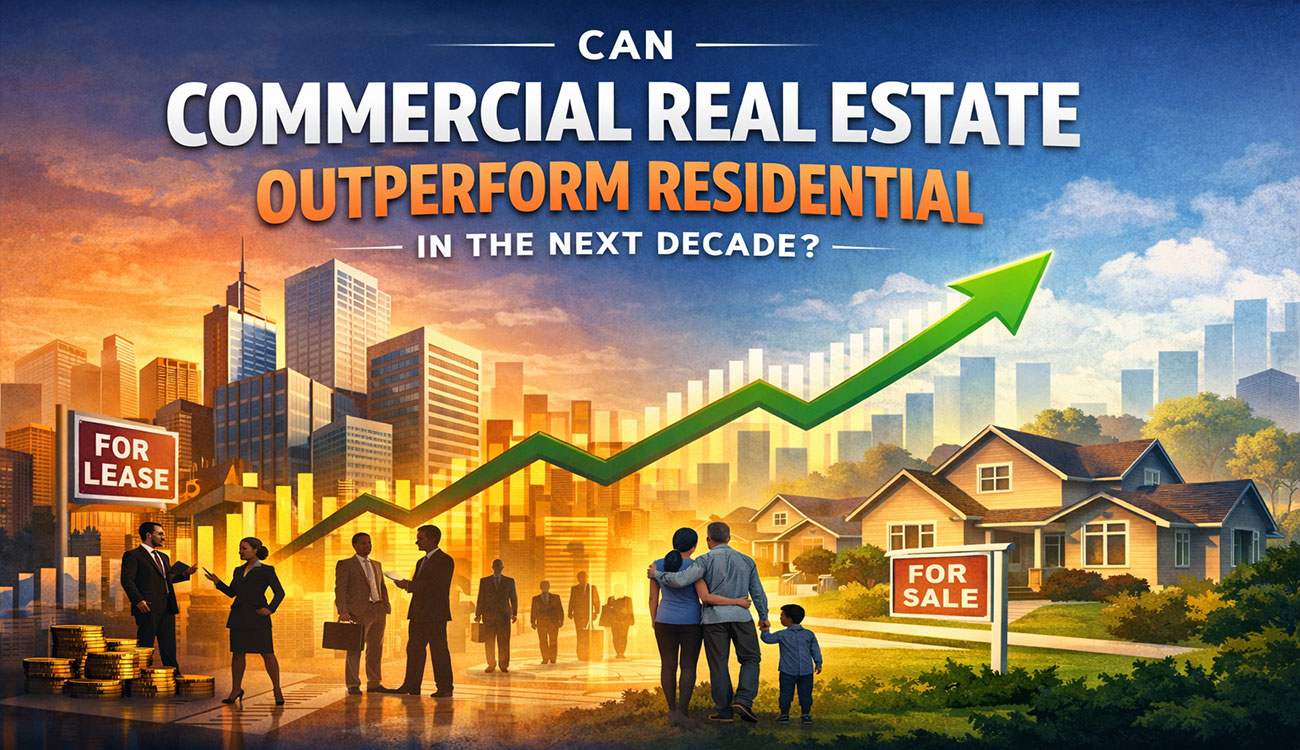
For decades, residential real estate has been the default choice for Indian investors. Homes are tangible, emotionally reassuring, and perceived as safer. Commercial real estate, on the other hand, has traditionally been viewed as complex, capital-intensive, and suited only for institutional or high-net-worth investors. However, structural shifts in the economy, work culture, consumption patterns, and capital markets are forcing investors to ask a serious question: can commercial real estate outperform residential real estate over the next decade?
This is not a question with a simple yes or no answer. Performance depends on multiple variables—returns, risk, liquidity, regulation, taxation, demand drivers, and investor behavior. To evaluate whether commercial real estate can outperform residential in the coming decade, one must move beyond surface-level yields and examine long-term fundamentals.
Understanding the Core Difference Between Residential and Commercial Real Estate
Residential real estate is primarily end-user driven. Demand is anchored in basic human needs—housing, family formation, migration, and lifestyle upgrades. Returns are typically derived from moderate rental yields and long-term capital appreciation. Volatility is relatively lower, and emotional ownership plays a strong role.
Commercial real estate, in contrast, is cash-flow driven. Demand depends on business activity, corporate expansion, consumption cycles, and economic growth. Assets include offices, retail spaces, warehouses, logistics parks, and mixed-use developments. Here, rental yield is the dominant return driver, while capital appreciation is often linked to income stability and lease quality.
This fundamental difference shapes how each asset class behaves across market cycles.
Historical Performance: Yield vs Appreciation
Historically, residential real estate in India has delivered modest rental yields, typically ranging between 2% and 4% annually, with returns largely dependent on capital appreciation over long holding periods. Appreciation, however, has not been linear and has varied significantly by micro-market.
Commercial real estate has consistently offered higher rental yields, often in the range of 6% to 9% for well-leased assets. In some pre-leased or Grade-A assets, yields have exceeded this range. Over the past decade, even when capital values stagnated, steady rental income helped commercial investors maintain overall returns.
This yield advantage forms the foundation of the argument for commercial real estate outperformance.
Structural Shifts Favoring Commercial Real Estate
Formalization of the Economy
India’s economy is steadily formalizing. GST implementation, digital payments, and compliance-driven growth have pushed businesses into organized spaces—office buildings, formal retail, and regulated warehouses. This structural trend increases long-term demand for quality commercial assets.
Growth of Logistics and Warehousing
The rise of e-commerce, quick commerce, and pan-India supply chains has transformed logistics from a niche segment into a core real estate asset class. Warehousing and logistics parks are witnessing strong absorption, long lease tenures, and institutional participation.
REITs and Institutional Capital
The introduction of Real Estate Investment Trusts (REITs) has changed how investors access commercial real estate. REITs have brought transparency, liquidity, and governance, attracting both domestic and global capital. This institutionalization supports valuation stability and professional asset management.
The Office Market: Decline or Reinvention?
The work-from-home narrative initially raised concerns about office demand. However, the reality is more nuanced. While hybrid work has reduced per-employee space in some sectors, overall demand has been supported by:
- Growth of GCCs (Global Capability Centers)
- India’s continued cost advantage for global firms
- Expansion of technology, consulting, and R&D sectors
- Preference for Grade-A, amenity-rich office campuses
Rather than collapsing, the office market is undergoing flight to quality, benefiting well-located, well-managed commercial assets.
Retail and Consumption-Led Growth
Organized retail is another segment where commercial real estate could outperform residential. As consumption rises and brands seek experiential formats, demand for high-quality malls and high-street retail in prime catchments remains strong.
Unlike residential rentals, retail leases often include escalation clauses and revenue-sharing components, allowing landlords to participate in business growth.
Risk Profile: Stability vs Sensitivity
Residential real estate benefits from diversified demand. Even during economic slowdowns, housing demand rarely disappears—it slows. Rental income, while modest, is relatively stable.
Commercial real estate is more sensitive to economic cycles. Business closures, downsizing, or sectoral disruptions can impact occupancy. However, this risk is mitigated in:
- Pre-leased assets
- Properties with blue-chip tenants
- Assets diversified across multiple tenants and sectors
Over the next decade, risk-adjusted returns will depend more on asset selection than asset class alone.
Liquidity and Exit Considerations
Residential real estate enjoys superior liquidity. Smaller ticket sizes and emotional demand make exits easier, especially in end-user markets.
Commercial real estate has historically been less liquid, but this is changing with:
- REIT exits
- Growing secondary markets for leased assets
- Increased participation from family offices and HNIs
Liquidity gaps still exist, but they are narrowing for high-quality assets.
Taxation and Cash Flow Efficiency
From a cash-flow perspective, commercial real estate often benefits from:
- Higher rental yields
- Longer lease tenures
- Contractual rent escalations
However, taxation on commercial rentals can be higher, and GST implications may apply depending on asset type and structure. Residential rentals, while lower yielding, enjoy simpler tax treatment and fewer compliance layers.
Investors must evaluate post-tax returns, not just headline yields.
Capital Appreciation: Not the Same Game
Residential appreciation is driven by land scarcity, infrastructure development, and end-user demand. It can be explosive in emerging corridors but stagnant in mature markets.
Commercial appreciation is tied to income stability. Assets with strong leases, tenant retention, and professional management tend to re-rate over time, especially when acquired below replacement cost.
Over the next decade, appreciation in commercial assets is likely to be steady rather than speculative, favoring disciplined investors.
Who Should Prefer Commercial Over Residential?
Commercial real estate may outperform residential for investors who:
- Seek predictable cash flows
- Have higher risk tolerance
- Can evaluate tenant quality and lease structures
- Are comfortable with longer holding periods
Residential real estate may remain superior for investors prioritizing:
- Emotional security
- End-use flexibility
- Easier liquidity
- Lower complexity
The Next Decade: A Balanced View
The next decade is unlikely to produce a clear winner across all metrics. Instead, commercial real estate is positioned to outperform residential on yield and cash-flow efficiency, while residential will continue to dominate in emotional value, liquidity, and end-user demand.
The real opportunity lies in portfolio balance. Investors who allocate capital intelligently across both segments—using residential for stability and commercial for income—are likely to achieve superior risk-adjusted returns.
Conclusion
Commercial real estate has evolved from a niche investment into a structured, institutionally supported asset class. With higher yields, improving liquidity, and strong structural demand drivers, it has credible potential to outperform residential real estate in the next decade—but only for informed, selective investors.
Outperformance will not come from indiscriminate buying. It will come from understanding leases, tenants, locations, and long-term demand trends. Residential real estate will remain relevant, but commercial assets are increasingly becoming the engine of consistent income generation in real estate portfolios.
Build a Smarter Real Estate Portfolio
At Horizon, we help investors evaluate residential and commercial opportunities with a data-driven, advisory-first approach—so your capital is allocated where it works hardest over the long term.