


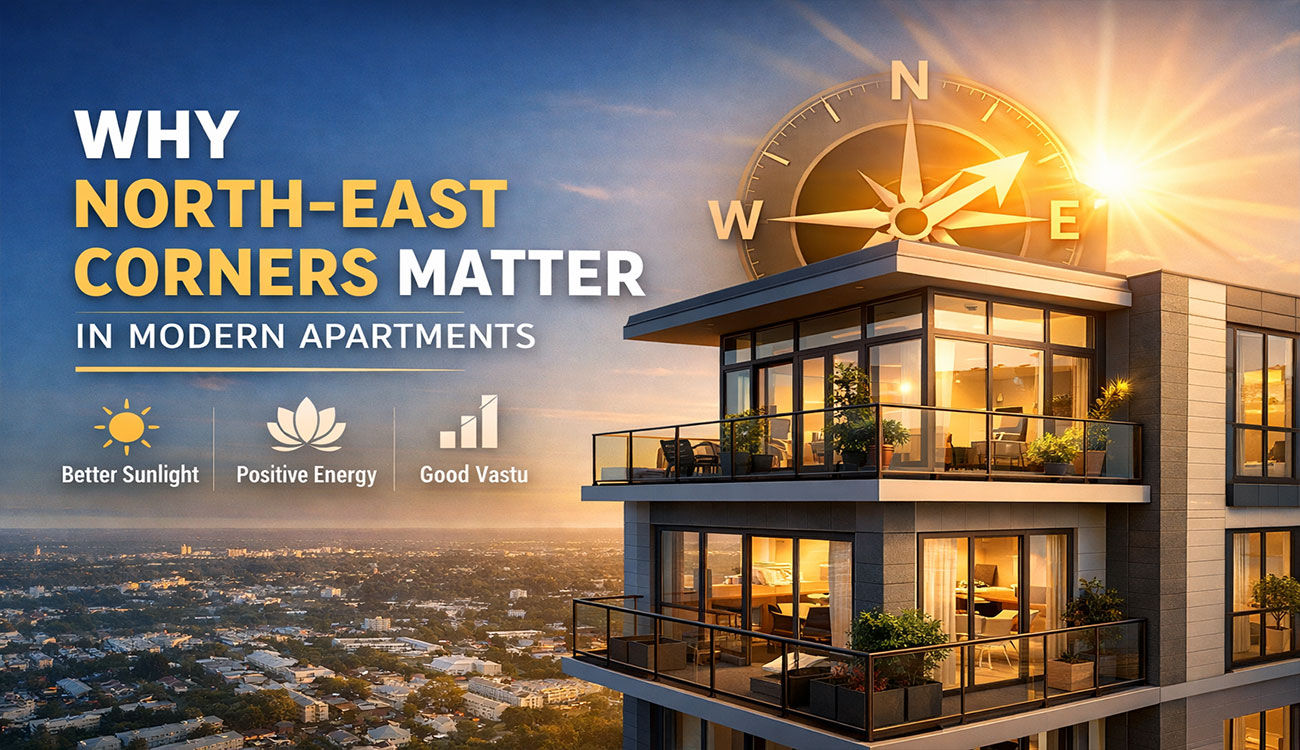
In Indian homebuying, few concepts generate as much discussion as the North-East (NE) corner of a home. Traditionally rooted in Vastu Shastra, the importance of the North-East corner has evolved beyond spiritual belief into a blend of science, design logic, environmental planning, and market perception. Even in modern high-rise apartments—where layouts are dictated by structural grids, regulations, and vertical living—the North-East corner continues to influence buyer preferences, rental demand, and resale value.
Understanding why the North-East corner matters today requires moving past superstition and examining how light, ventilation, spatial planning, psychology, and buyer behavior intersect in contemporary apartment design.
The Traditional Foundation of the North-East Corner
In Vastu Shastra, the North-East corner—also known as Ishanya—is considered the most auspicious zone of a home. It is associated with clarity, positivity, and balance. Traditionally, this zone was kept light, open, and uncluttered, often reserved for prayer rooms, water bodies, or open courtyards.
While modern buyers may not strictly follow Vastu rituals, the underlying logic behind the North-East zone remains relevant. Many of these principles align naturally with climate-responsive architecture and human psychology, which explains why NE-facing apartments still command attention in urban real estate markets.
Natural Light: A Scientific Advantage
One of the strongest practical reasons the North-East corner matters is natural light quality. In the Indian subcontinent, North-East directions receive soft, consistent morning light without the harsh heat associated with west-facing exposures.
Apartments with living rooms or bedrooms in the North-East benefit from:
- Reduced heat gain
- Brighter interiors during daytime
- Lower dependence on artificial lighting
- Improved thermal comfort
Over long periods, better daylight exposure enhances mental well-being and reduces energy costs—factors that directly influence livability and long-term satisfaction.
Ventilation and Air Flow Benefits
In many Indian cities, prevailing wind patterns allow better cross-ventilation when openings are aligned toward the North-East. Apartments designed with balconies, windows, or open spaces in this zone often experience:
- Improved air circulation
- Reduced humidity build-up
- Better indoor air quality
These advantages become especially noticeable in dense urban developments, where ventilation challenges are common. Buyers may not always articulate this scientifically, but they often feel the difference during site visits.
Psychological Perception of Space and Calm
Homes with North-East-oriented living areas often feel calmer and more balanced. This is not accidental. Soft daylight, cooler temperatures, and quieter exposure (away from harsh afternoon sun and busy western roads) create a sense of composure.
From a buyer psychology standpoint:
- NE-facing homes feel more welcoming during walkthroughs
- Spaces appear brighter and more spacious
- There is a subconscious association with positivity and order
These perceptions play a critical role in decision-making, particularly when buyers compare multiple similar apartments.
North-East in High-Rise Apartment Planning
In modern apartments, especially in high-rise towers, buyers rarely get an entire cardinal-direction-facing home. Instead, corners, room placements, and window orientations matter more than the main door direction.
Developers who consciously design:
- Living rooms in the North-East quadrant
- Balconies opening toward NE
- Bedrooms away from harsh western exposure
often see stronger buyer response. Such layouts are perceived as premium, even when pricing is similar.
Vastu Compliance as a Market Signal
Whether one personally believes in Vastu or not, market behavior clearly shows its influence. A large segment of Indian buyers filters properties based on Vastu compliance, with the North-East corner being a non-negotiable factor.
As a result:
- NE-compliant apartments enjoy faster absorption
- Rental demand is stronger among family tenants
- Resale negotiations are smoother
In many projects, apartments with favorable NE layouts are sold earlier, often at marginally higher prices.
Impact on Rental Demand
Tenants—especially families—often prefer homes that are well-lit, ventilated, and perceived as positive. North-East-aligned apartments tick these boxes.
From a landlord’s perspective, such homes tend to:
- Rent out faster
- Experience lower vacancy periods
- Attract long-term tenants
Even corporate tenants and expatriate renters, who may not explicitly seek Vastu compliance, respond positively to the comfort and brightness associated with NE layouts.
Resale Value and Liquidity
In resale markets, where buyers compare multiple listings within the same project, orientation becomes a differentiator. North-East corner units often enjoy:
- Higher inquiry volume
- Better negotiation power for sellers
- Quicker transaction closure
Liquidity is a critical but underestimated aspect of real estate investment. Homes that appeal to a wider buyer base are easier to exit, and NE-oriented apartments consistently score higher on this parameter.
Common Misconceptions About North-East Apartments
One misconception is that an apartment must face North-East entirely to be considered good. In reality, partial NE compliance—such as living spaces, windows, or balconies in that zone—is often sufficient in modern layouts.
Another myth is that NE compliance guarantees success or prosperity. While no orientation can replace financial planning or life choices, NE-aligned homes do support comfort, mental well-being, and market desirability.
When North-East Matters Less
There are situations where NE orientation becomes secondary:
- In ultra-dense CBD locations where view and floor height dominate
- In luxury homes with advanced climate control and design
- In purely investment-driven short-term trades
However, even in these cases, NE-aligned layouts rarely become disadvantages—they simply become one factor among many.
How Smart Buyers Should Evaluate NE Compliance
Rather than rigidly applying Vastu rules, buyers should:
- Assess natural light during site visits
- Check airflow and window placement
- Understand heat exposure throughout the day
- Balance NE preference with layout efficiency and view
This practical approach ensures decisions are rooted in comfort and value, not blind belief.
The Modern Interpretation of Vastu
Modern real estate is increasingly adopting a functional interpretation of Vastu—one that aligns traditional wisdom with architectural science. The North-East corner’s importance fits seamlessly into this framework, offering benefits that are tangible, measurable, and market-driven.
Developers who respect these principles without compromising on design efficiency often deliver homes that age better, perform better, and retain value longer.
Conclusion
The importance of the North-East corner in modern apartments is not just cultural—it is practical, psychological, and financial. From better daylight and ventilation to stronger buyer preference and resale liquidity, NE-aligned homes offer advantages that go beyond belief systems.
In an era where apartments are increasingly standardized, subtle design advantages like North-East orientation become powerful differentiators. Buyers who understand why it matters—not just that it matters—are better positioned to choose homes that deliver comfort today and value tomorrow.
Choose Homes That Perform Long-Term
At Horizon, we evaluate apartments beyond brochures—factoring in orientation, livability, Vastu logic, and resale strength—so you invest in homes that truly stand the test of time.